An introduction to the ITIL v3 framework
The five books of ITIL v3
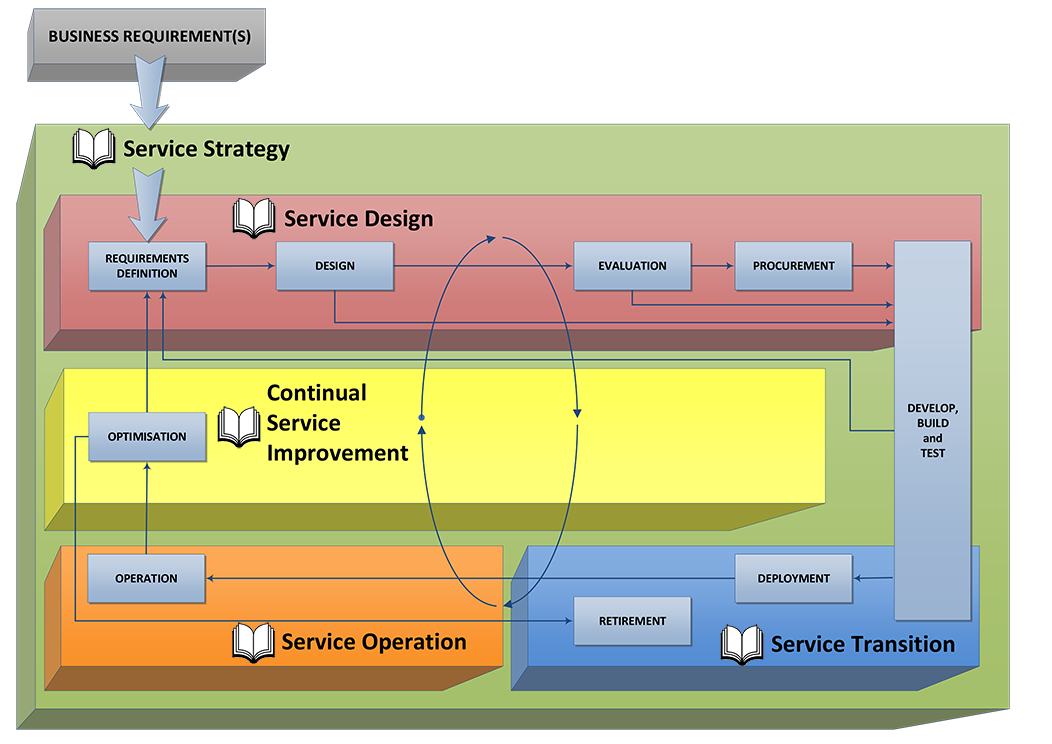
ITIL v3, which was last published in 2011, is formed of five books:
Service Strategy
Service Strategy provides advice and guidance on designing, developing and implementing service management – both as an operational capability within an organisation but also how to use that capability as a strategic asset. It tries to ensure that consideration is given as to why a particular activity is to be performed – before an organisation begins to think about how it will be performed.
Service Design
The Service Design stage of the lifecycle starts with a set of new or changed business requirements and ends with the development of a solution designed to meet the documented needs of the business. This developed solution, together with its service transition pack, is then passed to Service Transition to build, test and deploy the new or changed service and on completion of these activities control is transferred to the Service Operation and Continual Service Improvement stages of the service lifecycle.
Service Transition
The Service Transition stage of the lifecycle provides guidance on ensuring that the introduction, deployment, transfer and decommissioning of new or changed services is consistently well managed. Service Transition ensures that the transition processes are streamlined, effective and efficient so that the risks relating to the service in transition are minimised. Successful Service Transition depends on an effective understanding and application of the Change Management process as well as quality assurance, risk management and effective programme and project management. The Service Transition stage of the lifecycle receives input from the Service Design stage and provides output to the Service Operation stage.
Service Operation
Service Operation is responsible for all aspects of managing the day-to-day operation of IT services, ensuring that processes and activities are operated (and continue to be operated) on a ‘business as usual’ basis. Its key purpose is to coordinate and perform the processes and activities that support the delivery of the IT services at the levels defined in the relevant service level agreements. The scope of Service Operation covers the IT services, the service management processes, the underpinning technology used to deliver those services – and the people used to manage all of these aspects.
Continual Service Improvement
Continual Service Improvement is not a lifecycle stage, but a wrapper used throughout the whole service lifecycle. It has inputs and outputs for all lifecycle stages. It focuses on the overall health of Service Management within the organisation.
[Note: Click on each of the headings to read more about that particular book.]
How do the five ITIL v3 books relate to one another?